Sunday, 9 November 2014


INDIA’S ENERGY SECURIT: RENEWABLE SOURCES OF ENERGY

As we already know that India's energy mix is heavily skewed in favor of conventional sources of energy, more particularly Coal and Big Hydro Plants, there is growing clamour for Inreasing share of Renewable energy. Renewable sources of energy mainly includes – Solar, Wind, Small Hydro, Waste to Energy, Bio energy. These have numerous advantage over conventional. All conventional resources use a scarce resource which is expected to exaust in near future. Even Hydro power falls in this category as water is a scarce resource and we have seen that countries are having hard time securing their future water needs. Renewable sources on the other hand, uses resources which are abundant from nature. Wind and Solar resource wont exhaust even if fully exploited. Other renewable sources such as waste to energy, bio energy aims to turn waste into resource.
This character of renewable sources is also expected to give cost advantage over other sources, once current technical and economic barriers are overcome. Like there is coal market, oil market there cannot be any market of wind or solar resources in future resulting in fluctuations in raw material material prices. Hence only cost is Infrastructural and Operational cost is mainly of management and mantainence.
Another strong argument is of environmental costs of conventional sources which are enormous. While doing cost benefit analysis if we include costs of damages to ecology then renewable energy is preferable even if its current economic costs are substantially higher.
Combustion of fossil fuels emmits greenhouse gasses such as Carbon dioxide, Carbon Monoxide, Nitrogen Oxide, Sulphur dioxide, methane. Coal undergoes incomplete combustion which emmits Carbon Soot and more carbon monoxide, these both causes respiratory problem. Carbon Monoxide is extremely poisnous and has affinity with Haemeoglobin cells, hence it can elleminate oxygen from human cells.
Further coal mining operations are one of the riskiest jobs and results in gross violation of human rights of miners to have safe working envirinment. Their have been many instances where miners got killed due to mining roof collapse or suffocation by hazardous gases such as Methane. Similarly Oil rigs and pipelines have time and again leaked in seas causing havoc with marine ecology and biodiversity.
Nuclear Energy as we have seen, gives hazardous radioactive wastes which are to be handled for hundred of years. Any accident can cause genetic mutations in the affected people. Further, use of nuclear energy might have some link with corresponding Increase in nuclear arms because of growth and free flow of nuclear knowledge, which is beyond any one's control.
In this backdrop, fortunately, costs of clean energy, particularly of Wind and Solar is falling from few years. There has been technological barriers and unsupportive external environment , which is now turning around by increasing competition in Industry and Indegenious innovations too. Further government's attempts of positive intervention by diplomacy with countries such as Germany is expected bring many benefits.
Advocacy for renewable energy also came from United Nations, through its 'United Nations Framework Convention on Climate Change' in pursuance of which India adopted National Action Plan For Climate Change ( NAPCC). This action plan has 8 core mission. Among them 2 missions ie. 'National Solar Mission' and 'National Mission for Enhanced Energy effeciency' have direct bearing on the chapter.
Around 23 % of rural India continues to use Traditional Fuels such as firewoods, Crop residue and dungcakes. This too have environmental and health concerns as their combustion releases poisonous gasses. It also brings hardship on rural women and girls as they spend substantial time on collecting this fuel. In recent years decentralised clean energy sources have increased and Use of portable solar cookers is catching up. This is important part of government agenda of 'Inclusive and Sustainable development'
India's domestic renewable power generation base is expanding rapidly on the back of various incentives such concessional loans, Tax holidays, 100 % depriciation allowance etc. Govt. has also allowed 100% FDI in renewable energy and there is interaction of government in this field with about 22 countries. As a result sector is growing at 20% from last 5 years.
Wind energy is dominant source, followed by biopower , small hydro and solar energy (See piechart) and India ranks 5th in renewable power globaly. 12th plan envisages development in foolowing manner ( this data is for Grid Interactive power generation)-
  1. Wind energy – 15000 MW
  2. Solar Energy ( both photovoltaic & Thermal) – 10000 MW
  3. Bio energy – 500 MW
  4. Small Hydro – 2100 MW
  5. Baggase Cogeneration – 1400 MW
Total target from renewable sources is 55000 MW ( total target of 318000 MW)


1982 – Department of Non Conventional Energy Sources under ministry energy
1992 – Converted to Ministry of Non conventional Energy Sources
2006 - namne changed – Ministry of New and Renewable Energy
Under Ministry there is Indian Renewable Energy Development Agency (IREDA), to promote, develop and extend financial support for renewable energy and energy efficiency.
Now ministry is under Minister of State Mr Piyush Goyal, which also wolds Ministry Of power and Ministry of Coal. This integeration is expected to bring more clarity and Integerated approach.
Germany – As an example
Germany, on the back of government support through generous subsidies is undergoing landmark shift towards clean energy. Currently about 25 % of energy is renewable backed and plan for 2050 and 2080 is for 50% and 80% of clean energy. Further, after Fukushima disater they have dicided to completely get rid of Nuclear Energy in gradual manner.
In Germany, allmost every houshold has small Solar photovoltaic plant at its roof top and they sell surplus energy to national grid utilities. People have been gauranteed purchases at lucrative rates for coming decades by government.
There is 'Indo- Germany Energy Forum' for deepening cooperation in matters such as energy effeciency, Grid improvement and promotion of clean energy.
United States too is engaged with India over clean energy. In 2005 US-India Energy Dialogue took off which focused, among other thing, on low carbon energy. Recently Indian PM on visit to US concluded Indo- US energy partnership, under which USA agreed to extend $1 Billion loan (by 'US export import bank' to IREDA) for grid connected projects.
National Clean Energy Fund
This is Non lapsable fund established in 2011 to promote research & development in clean energy. It draws funds from coal mined or imported which are levied Clean energy cess at Rs 50/ Ton. This is in pursuance to 'polluter pays' principle. Fund is mainly to be utilised for promotion of renewable energy,cleaner energy (CBM , Shale gas etc) grid improvement etc. Having said this, corpus of fund is severly underutilized and misutilised. Misutilised in sense that grants from this funds are being used for making good budgetary shortfalls, rather than for R&D.
Renewable Energy Certificates (RECs)
There is 'renewable purchase obligation policy' in place ( under electricity act 2003), under which Distribution companies ( DISCOMS) have obligation to purchase certain amount of renewable energy(fixed %age of their total electricity supply). This was needed because renewable energy is expesive when compared to conventional sources. To fullfil this obligation, they can alternatively buy RECs from renewable power producers. A producer gets 1 REC when 1 MWh ( megawatt hour) power is fed to the grid. When he sells this certificate in market or to the DISCOM, money he earned will reduce cost of power generated.
This came in 2010 and now there is a market for RECs.Its price will fluctuate as per demand from DISCOMS. Demand will be more when price difference between two types is more or when there is sudden surge in total electricity supplied. DISCOMS will do cost benefit analysis of wether its benificial to buy 'Expensive' renewable energy or to buy certficate and get rid of 'obligation to buy'. It all depends upon prices of all variables.
RECs are a policy mechanism to promote renewable energy based power generation in India. Technologies such as wind, solar PV, solar thermal, biomass and hydro are eligible to earn RECs. Renewable power producers can earn additional incomes by trading these certificates. These are tradable on power exchanges.
Off Grid/ Interactive Grids
Renewable energy systems can be either standalone ( off grid ) or Grid Interactive ones. Former use energy for their own need such as solar tubelighs, Solar waterpumps, Solar water heaters. There can also be standalone power plants based on wind, solar , small hydro or biomass energy which power a particular locality, industry, remote area etc. These will be off grid if not connected to national grid.
Grid Interactive systems are connected with national grid. Roof top solar panels can also be grid interactive. Thses are smart systems, which can convert Direct current to Alternating current in order to have interface with grid. They manage supply to users by automatically switching to grid power in case renewable source is out of power due to bad weather. These include 'advances metering system' which takes into account power generated by renewable source of a house/industry/ locality and deducts it from total electricity bill. Further, these also have facility of transfering surplus electricity to national grid.
Variability Problem of renewable energy
As we know weather is variable and so is sunlight and wind. Wind is not present at all times, even if present doesn't blow at same speed and direction. This will result in variation in speed of wind mills, in turn of Turbines. Same is true for solar plants as sunrays warry throughout day in in intensity depending upon time of the day and clouds in the sky. This results in fluctuating voltage. When proportion of this variable power is high as to total power on grid, then wastage,ineffeciency and losses increase. To remedy this problem Smart Grids are required which are capable of self adjustment.
To address this variability problem government planned to launch Rs 43,000-crore'Green Energy Corridor' project to facilitate the flow of renewable energy into the national grid.
 The project will be implemented with the assistance of Germany who has promised provide developmental and technical assistance of euro1 billion for the project.

 
Objective is of Synchronizing electricity produced from renewable sources, such as solar and wind, with conventional power stations in the grid.
The whole project has been divided into two parts:
1. Inter State- To be developed by State utilities.
2. Intra State- To be developed by Power Grid Corporation of India (PGCIL).
 The planned transmission system would be made dynamic to handle the variations leading to an integrated grid across the nation.

Another important method to reduce variability is to go for Hybrid Wind-Solar power plants. At many places where both wind and solar assessment is positive these' two in one' plants could be installed. Battery bank is used to store power. First such plant was in Haryana at Morni Hills.


Wind Energy
Wind energy holds largest share in renewable energy in India and also in most of the countries. Current capacity is of about 21 GW. Government has lauched a 'Wind Resource assessment Programme' under which more than 700 'wind monitoring centers' have been established at various locations all over the country. These assess potential at various heights. Wind energy potential grows with heights. At 50 m height potential is about 49 GW and at 80 m its 103 GW (Total potential = 152 GW). Highest potential is in Gujrat, followed by Karnataka, Tamil Nadu and Andhra Pradesh.
Wind energy requires huge tracts of land and this is major constraint in India . Above given potential is based on assumption that 2 % of land ( .5% in hilly areas) will be available for the sector. Further, potential for Off shore wind energy is also under assessment. Here wind mills are erected on continental shelves. Globally 7 GW is harnessed from Offshore Wind Plants. Some International Journals put India Offshore energy potential at 350 GW. Prelimnery Assessment indicate reasonable prospects of offshore wind energy in Gujrat, Maharashtra and Tamil nadu
Government came out with 'Generation Based Incentive scheme' which allows 'Independent Power prodecers' and FDI in the sector. This scheme was recontinued after it was discontinued in 2009. It currently allows disbursal or subsidy upto rs 1 Crore/ MW generation of power. Under revised scheme capacity of 2100 MW has been added.
However, wind mills have been dangerous for threatened birds. Time and again carcasses of Flamingoes, Great Indian Bustard,White Backed Vulture, Sarus Crane are found near wind mills which die of collission with moving blades.
Waste to Energy
Biomass Power and Bagasse Co-generation Programme
Biomass power is derived from agricultural residue like husks, shell, strew, deoiled cakes ( from solevant plants – resudue of oil) etc. These are put in high pressure boilers and its stream is used to turn turbines.
Bagasse is fibourous residue of sugarcane which is left after extraction of Juice. This has been traditionally used by Sugar Mills in various processes such as boiling. With advancement of technology
more efficient and small turbines are in market which can be used to generate electricity.Stream generated can be partially or fully used to turn turbines along with providing energy directly for other processes.This is called cogeneration.This can be captive power plants for sugar mills and they can sell surplus power in markets if they are connected with grids.
Combined power generation capacity is about 4 GW.
Potential assessed is 17000MW for biomass power and 5000 MW for bagasse based power
Energy From Municipal Waste
This involves thermal treatment which is called 'incineration'. This involves combustion of waste to generate stream. This is quite popular in developed countries as it also addresses waste management problems. But this is vehemently opposed by environmentalists, over claims of release of poisonous gases. Further,as raw material is municipal waste , it is generally in vicinity of residential area. There are disagreements over its treatment as renewable source of energy.
MNRE classifies this as renewable energy as it is claimed that modern combustion facilities and air treatment are state of art and results in complete combustion and minimal emmission of gasses. Further, it converts waste in energy and turns a liability into an asset. Waste left into landfills emmits methane gas which is potent greenhouse gas and this is saved by waste to energy plant.
India's first such plant is in Okhla near Delhi. Residents of Okhala appealed to National Green Tribunal against this plant. NGT got a study conducted and found that air quality in that area was hazardous.
Small Hydro Power
Small Hydro Power potential is assessed at 20000 MW out of which approx. 3800 MW is being currently harnessed. This source is significant for electrification in remote and isolated areas. Problems assocciated with large dams such as deforestation and displacement of people is not there in this case. Small hydro power Program is in place under Ministry of New & Renewable Energy, under which about 6200 sites have been identified. Projects under 25 MW are classified under this category. They doesn't need EIA and are elegible for financial assistance of government. Many states too have policy toward SHP.
Prime Minister last year announced for electrification of border villages of Arunachal Pardesh by small hydro and 1058 villages have been electrified.


Solar Energy 
Solar panels in past years were quite expensive which made this sector perform poorly by making this energy uncompetitive to Conventional energy sources. Note in preceding graph/data that solar energy despite of having good potential ranks at 4th, behind all other sources. Fortunately from last few years prices are consistently falling. Recently a MP government tender for purchase of solar energy was released at Rs 6.5/ Unit which is just 14 % more than cost of thermal energy. This fall is due to fall in prices of Photo voltaic panels because of increased competition, more efficient production and economies of scale. Further, India's largest solar plant is planned in Madhya Pradesh for 700MW, which is expected to generate electricity at Rs. 5.40 /unit.
It is hard to quantify potential of solar energy because it's directly proportional to area covered by PV cells. Yet one can have idea by the fact that most parts of India receives, clear sunlight for 300 days a year. Another estimate suggests that if 10 % of India's land is put under solar panels; we'll get 8000 GW of energy, which is about 50 times higher than current generation.

Jawaharlal Nehru Solar Mission
Launched in 2010 under 'National Action Plan for Climate Change' will be implemented in 3 phases. 1st phase is over and 2nd is going on. Targets under the Mission are –
  1. Deployment of 20000 MW of 'Grid connected' solar power by 2022 (1st phase target 1100 MW)
  2. 2000 MW of 'Off grid solar applications' and 20 million 'solar lights' by 2022 ( 1stphase target 200 MW)
  3. 20 million sq. km of 'solar collector area' ( for solar water heaters , 1st phase target is 70 lakh sq. km)
  4. Creating favorable conditions for solar manufacturing facilities
  5. Support R&D and capacity building to achieve ' Grid parity' by 2022
1st phase got over in March 2013 and Grid connected solar power target of 1100 MW was achieved comfortably.
Highest capacity is in Gujrat followed by Rajasthan
Under the mission new solar plants will be eligible for Viability Gap Funding from 'National Clean Energy Fund' which shall comprise of 30 % of the project cost. This will be given in instalments after commissioning of the project.
Batch 1, of 2nd phase of mission aims for 750 MW capacity of grid connected plants. Mission also has a clause for 'Domestic Content requirements' by which 375 MW of project investors will need to source certain proportion of solar PVC and modules from domestic suppliers.
USA dragged India to WTO over this issue alleging that it violates GATT and Trade related Investment measures (TRIMs). For this WTO has recently constituted a 'Dispute settlement Body'.
Cardinal principle behind these agreements is of 'National Treatment' of foreign goods as per which imported goods once entered in market shouldn't face any discrimination vis a vis domestic goods. US alleges that this principle is violated because of 'domestic content requirements'
Grid Interactive Rooftop and small SPV power plants
Rooftop solar panels can make huge environmental and economic impact at macro level. This will reduce electricity expenditure of households. This system can also provide electricity backup to users at time of outages. These systems use solar inverters to change DC power generated by SPV power plants to AC to feed the grid (solar cells and batteries generate DC power, whereas electricity generated through turbines is AC power). Central govt. provides 'Central Financial Assistance' for these plants to make electricity cheaper.


Off Grid Solar Photovoltaics (standalone)
Government provides subsidy of 30 % of project costs to maximum of Rs 135 / watt (90% up to Rs. 405/watt
for North East, J&K, UT islands, districts with International borders). Major projects sanctioned included solar streetlights, study lamps, SPV pumps and small power plants.
Solar Water Heating System
Depending upon location a 100 liter capacity water heater can save annual 1250 units and 1.25 ton of carbon dioxide. Under JNNSM 70.01 lakh sq. km. collector area has been achieved in 1st phase. 80 % of the installations were in residential areas. Capital subsidy of 30 % is available.
Off Grid Solar Heater Program
Objective of this program under mission is to promote off grid applications of solar thermal power such as solar cooker, solar air/water heating system.
It also include Concentrated Solar Thermal technologies (CST) for community cooking, process heat and cooling application 

Hence renewable energy might be answer to environmental and economic woes of current energy mix. If we compare seriously all costs of various alternatives of power, we'll conclude that renewable energy should get dominant attention of our policy makers. To achieve rapid progress in the sector it is essential that Industrial base be developed to ensure supply of adequate technology and continuous innovation directed towards efficiency. This should be coupled with robust demand which will also need government support. Overtime Solar PVC, small wind mills, Small hydro will become part of common man's life in India. This is best way to electrify whole India in a sustainable way.


Special Report – Pradhan Mantri Jan Dhan Yojna

Summary:
  • It is one of India’s ambitious financial inclusion schemes that aims to provide basic banking and micro insurance services to India’s poor.
  • The scheme is unprecedented in scale and coverage as more than 1.5 crore or 15 million bank accounts were opened in a single day when PM launched the scheme on August 28.
  • Public Sector banks have opened nearly 6.5 crore accounts against the target to open 7.5 crore bank accounts before 26 January next year.
  • Under the scheme an account holder is entitled to one lakh rupees accidental death cover and 30,000 rupees life insurance cover.
  • It provides universal access to banking services.
  • Basic bank accounts with overdraft facility are provided. Financial literacy program will also be rolled out. Credit guarantee fund will also be constituted.
  • This scheme is also being seen as one strong pillar of vast number of initiatives and schemes that have taken place over the years.
  • Experts point out that, if implemented properly, the Jan Dhan Yojana has the potential to wipe out the financial untouchability.
  • There is a lot of scope for improvement in the way the scheme is implemented at the ground level.
  • Long cue can still be seen outside bank branches. Despite the government’s promise to open at least 2 accounts per household, many still haven’t made it even to their first one.
  • Poor internet connectivity and cumbersome process are acting as impediments for smooth implementation of the scheme. This gets even worse in remote areas where the largest section of targeted group lives.
  • Public sector banks are finding it difficult to cope with the rush.
  • This scheme is demand driven.
  • Despite the massive publicity, several people from the targeted section are not yet aware of the scheme.
  • The connectivity becomes very much important as the money is transferred from the government on online basis.
  • There are about 50000 villages in the country which do not have internet connectivity or have poor connectivity.
  • Public sector banks who are at the forefront of this massive financial inclusion program have urged the centre, state governments and telecom service providers to take corrective measures.
  • Providing telecom services and ICT infrastructure in the remote parts of the country to bring the rural people into the financial system fold is critical to the scheme.
  • Communication remains a huge issue with huge illiteracy levels. Several parts are completely out of reach of any kind of media whatsoever.
  • Banks also need to streamline the process of enrolling people in the rural areas.
  • Under the PMJDY the banks are not mandated to collect the biometric data.
  • Many people are not happy with the overdraft facility of just 500 rupees. Banks and experts are divided over the issue. Banks defend their policy of enhancing the overdraft limit on the basis of credit history of account holders.
  • To create an environment for large scale implementation of PMJDY banking regulator RBI issued a circular allowing banks to open basic accounts even if the customer does not have officially valid documents. These basic accounts would be valid for one year. But the provision has not been implemented properly. It is because of lack of proper communication with bank agents.
  • The target group comprises people who often don’t have any official identification documents. These are the same people who suffer heavily at the hands of money lenders.
  • The recent Sharada Chit Fund scam is an eye opener for the policy makers. In this case lack of access to the formal financial system caused havoc to the millions of the lower and middle class as the chit fund company duped them of their life time savings. The Supreme Court ordered for a CBI probe.
  • In a developing nation like India, financial inclusion has been an ongoing process. Experts trace its roots to the Nationalization of banks in 1960s.
  • In the post-nationalisation era a significant move took place from -class- banking to -mass- banking.
  • Today public sector banks admit that financial inclusion programmes like PMJDY are a critical tool of overall national development.
  • Census data of 2011 says that out of 24.67 crore households in the country, 14.48 cr/ 58.7% of the households have access to banking services. 54% of the rural households are availing the banking services. In urban areas the situation is slightly better as 68% of the households have access to the banking services. This suggests that there is room to move in further.
  • At the end of March 2014 there were 1.15 lac bank branches and 1.60 lac ATMs in the country. Of this 38% of the bank branches and 16% of the ATMs are in rural areas. 1.4 lac bank correspondents are in rural areas. These correspondents represent banks to provide basic banking services. These correspondents need to be trained efficiently.
  • Experts suggest that mere increase in number of bank branches is not sufficient to implement financial inclusion. Banks need to change their approach completely with regard to economically weaker sections and become more poor- friendly.
  • There are lessons to be learnt from the success of the fast moving consumer goods and telecom companies in profitably catering to the lower economic strata of the society.
  • The current state of regulatory environment is also responsible for the sorry state of financial inclusion in the country.
  • Harnessing the wide network of post offices and fair price shops can help in increasing the financial inclusion.
  • Utilization of a network of private telecom operators and fast moving consumer goods companies can also help. Adhaar platform can also be used.
  • The objective of the financial inclusion program is to get rid of the money lenders.
  • There is widespread call for careful monitoring of the program. Financial inclusion programmes in the past have run into rough weather after initial signs of success.
  • There is purchasing power in rural areas waiting to be tapped.


Saturday, 8 November 2014


Communalism – Meaning and Issues

Communalism – Meaning and Issues

by INSIGHTS


Introduction
Communalism, is referred in the western world as a "theory or system of government in which virtually autonomous local communities are loosely in federation". Communalism is a political philosophy, which proposes that market and money be abolished and that land and enterprises to be placed in the custody of community.
Development of communalism as political philosophy, has roots in the ethnic and cultural diversity of Africa. It is characterized as, People from different ethnic groups or community, who do not interact much or at all and this has somewhere acted as hindrance in the economic growth and prosperity of Africa.
Communalism in South Asia is used to denote the differences between the various religious groups and difference among the people of different community. And generally it is used to catalyse communal violence between those groups.
Communalism is not unique only to South Asia, but is also found in Africa, America, Europe, Australia, and Asia. But, it is significant socio-economic and political issue in Bangladesh, India, Pakistan, Myanmar, Sri Lanka, Nepal, etc.
What is Communalism?
It is basically an ideology which consists of three elements:-
  • A belief that people who follow the same religion have common secular interests i.e. they have same political, economic and social interests. So, here socio- political communalities arises.

  • A notion that, in a multi-religious society like India, these common secular interests of one religion are dissimilar and divergent from the interests of the follower of another religion.

  • The interests of the follower of the different religion or of different 'communities' are seen to be completely incompatible, antagonist and hostile.
Communalism is political trade in religion. It is an ideology on which communal politics is based. And communal violence are conjectural consequences of communal ideology.
Evolution of communalism in Indian society
If we discuss about Indian society, we will find that, ancient India was united and no such communal feelings were there. People lived peacefully together, there was acceptance for each other's culture and tradition. For example, Ashoka followed religious tolerance and focussed mainly on Dhamma.
In Medieval period, we have examples such as- Akbar, who was epitome of secular practises and believed in propagating such values by abolishing Jajhiya tax and starting of Din-I- ilahi and Ibadat Khana. Same acceptance for different cultures and tradition was practised in several kingdoms throughout India, because of which there was peace and harmony, barring few sectarian rulers like Aurangzeb, who was least tolerant for other religious practises. But, such motives were guided purely for their personal greed of power and wealth.
Such rulers and actions by them like- imposing taxes on religious practises of other community, destructing temples, forced conversions, killing of Sikh guru, etc. were instrumental in deepening and establishing the feeling of communal differences in India. But, these incidents were not common as, huge majority of Indians were rural and were aloof from such influences and so people coexisted peacefully. Though, they were very rigid in practising their own rituals and practise, but it never became barrier in the peaceful coexistence. Overall, the Hindus and Muslims in those days, had common economic and political interests.
Communalism in India is result of the emergence of modern politics, which has its roots inpartition of Bengal in 1905 and feature of separate electorate under Government of India Act, 1909.Later, British government also appeased various communities throughCommunal award in 1932, which faced strong resistance from Gandhi ji and others. All these acts were done by the British government to appease Muslims and other communities, for their own political needs. This feeling of communalism has deepened since then, fragmenting the Indian society and being a cause of unrest.
(by Communal award colonial government mandated that consensus over any issue among different communities (i.e. Hindu, Muslims, Sikhs and others) is precondition for any further political development)
Communal consciousness arose as a result of the transformation of Indian society under the impact of colonialism and the need to struggle against it.
Stages in Indian Communalism and how it spread 
India is a land of diversity. And it is known for lingual, ethnic, cultural and racial diversity. As, we have discussed above, communalism in India is a modern phenomenon, which has become threat to India's Unity in Diversity. We will see the various stages:-
  • First stage was rise of nationalist Hindu, Muslim, Sikh, etc. with only first element of communalism as discussed above. Roots of this were led in later part of 19th century with Hindu revivalist movement like Shuddhi movement of Arya Samaj and Cow protection riots of 1892.

    On the other hand movements like Faraizi movement started Haji Shariatullah in Bengal to bring the Bengali Muslims back on the true path of Islam, was one of the religious reform movement which had bearing on communalism in 19th century. Later people like Syed Ahmed Khan, who despite of having scientific and rational approach, projected Indian Muslims as a separate community (qaum) having interest different from others.

  • Second stage was of Liberal communalism, it believed in communal politics but liberal in democratic, humanist and nationalist values. It was basically before 1937. For example organisations like Hindu Mahasabha, Muslim League and personalities like M.A. Jinnah, M M Malviya, Lala Lajpat Rai after 1920s

  • Third was the stage of Extreme Communalism, this had a fascist syndrome. It demanded for separate nation, based on fear and hatred. There was tendency to use violence of language, deed and behaviour. For example Muslim League and Hindu Mahasabha after 1937.
It spread as a by-product of colonialism, economic stagnations and absence of modern institutions of education and health. These factors caused competition, people started using nepotism (patronage bestowed or favouritism shown on the basis of family relationship, as in business and politics), paying bribes to get job, etc. Short term benefits from communalism started giving validity to communal politics.
Later on, spread of education to peasant and small landlords gave rise to new middle class, as agriculture was becoming stagnant. So, these people started demanding communal representation and this way, social base for communalism widened. Middle class oscillated between anti-imperialism and communalism. Communalism, started rooting deeply, as it was an expression of aspiration and interest of middle class for less opportunity.
Further, from very beginning upper caste Hindus dominated colonial services as they adapted early to colonial structure. Because of Mughal rule and 1857 revolt, colonial government was suspicious towards Muslims and they patronised Hindus. This resulted in resentment in Muslims in late 19th century and they then formed a pressure group under Sir Sayed Ahmed Kahn to bargain as a separate community. In contrast Congress standpoint was always focused on 'rights and freedom of individual' not on a particular community
In several part religious distinction coincided with social and class distinction, causing communal distortion. Communal outlook was given, not by participants but by the officials, politician and journalists. In fact agrarian conflicts, did not assume communal colour until 20th century. For example- Pabna agrarian movement.
Communalism represented a struggle between two upper classes / strata for power, privileges and economic gain. For Example- In western Punjab at that time, Muslim landlord opposed Hindu moneylenders. In eastern Bengal, Muslim jotedars opposed Hindu zamindars. Later on, communalism developed as weapon of economically and politically reactionary social classes and political forces.


Divide and Rule
Communalism was a channel for providing service to colonialism and the jagirdari class (land officials). British authorities supported communal feelings and divided Indian society for their authoritative ruling. As we have already discussed above about separate electorate, like that official patronage and favour having communal biasness was very common. Communal press & persons and agitations were shown extraordinary tolerance. Communal demands were accepted, thus politically strengthening communal organizations. British started accepting communal organisations and leaders as the real spokesperson of communities and adopted a policy of non-action against communalism. In fact, for the same reasons even the communal riots were not crushed. Separate electorate started in 1909 to communal award in 1932 fulfilled the wishes of British authorities of ruling India by dividing the societies on communal lines.
In parallel there was introduction of strong Hindu religious element in nationalist thoughts and propagandas. For example Bal GangadharTilak popularised Ganesh pooja and Shivaji Mahaotsav and taking dip in Ganga,etc. The programmes related to "Ganesh Pooja" and "Shivaji Mahotsav" was not initiated to support the interests of Hindus.  However, both "Ganesh" and "Shivaji" were associated with the emotions of a number of Hindus. This was to be used by Leaders as tool to politically awaken Indians. But, Indian history in schools and colleges were given Communal and unscientific colour. This kept Muslims largely away from Congress till 1919. In early decades only 8-9% of members of Congress were Muslims.
Gradually religiosity became major contributory factor and it started intruding the non-religious and non-spiritual areas of life and also beyond the individual's private life.
Though, India is a secular country but due to communal feelings the secularization is getting affected. Secularization is narrowing down the sphere of religion to the private life of the individual. So, communalism is basically becoming a belief system through which a society, economy, and polity are viewed & expanded and around which effort is being made to organise politics.
With these unprecedented changes, the best atmosphere of communal harmony should have been created in India and according to the expectation of Mahatma Gandhi this country should have become an example in this direction.  But this did not happen.  
Why communalism still persists and increasing in modern India?


Constitution of India, gives certain fundamental rights to the citizens (i.e. individuals). But in case of minorities, the whole community has been given fundamental rights under Article 28,29 and 30, according to which they are free to manage their educational institutions and have right to conserve their own culture. But these rights are being used, above the individual rights by the personal law boards guided by their own community laws. As it was seen in Shah Bano case.
There is also resentment against such personal laws and clamour is increasing forUniform civil code, which is also mentioned under Article 44 in Directive principle for states of Indian constitution. This will help in narrowing the religious cleavages.
In absence of Uniform civil code, there is still perception that all communities have divergent and contradictory interests. Consequently, community based pressure groups bargain for their own community. At political level these communities compete for power and resources. This competition, in turn, escalates to major conflicts. Politicians try to turn these communities into vote banks and different communities become watertight compartments. 
Since Independence, India has been pursuing the ideal of nation-building based on secularism. Even after 68 years of independence, India is still burning under the fire of communalism. Though, there are various reasons responsible for this. But few of them have been discussed here, understanding the reasons which play role in continuation of communalism are:-first one is religious, and the second one is political.  Third one is socio-economic and the fourth one is international.
In the first, i.e. religious, its fundamentalism should be considered responsible for communalism. After all, 'Our belief alone is true' and 'rest is untrue or incomplete', we find this kind of mentality of fundamentalists.  As per this mentality, when the followers of any religious community, sect or sub-sect indulge in their activities, they certainly come in conflict with others.  Reason is quite evident.  They do not have tolerance, which is absolutely necessary for a country like India–a land of different religious communities.  They become the cause of confrontation, malice and struggle.
Politicians also have played a villainous role in creating serious communal situations in India.  There was politics at the root of painful division of India in 1947 in the name of a particular religious community.  But even after paying a heavy price in the form of partition, in many riots provoked thereafter, we can find the involvement directly or indirectly, of political parties or their supporters.  Along with this for the sake of vote bank, the policy of appeasement, selection of candidates on the basis of community, sect, sub-sect and caste, and flaring up religious sentiments at the time of elections, led to the rise of communalism.  These practices are still continued and the country is bearing heavy loss because of it.  We can witness many adverse results of these practices.
Socio economic conditions of India, though after independence has improved and even the economic reforms after 1991 has been instrumental in improving such conditions, but still there are many challenges in front of Indian society, which are becoming threat for its diversity. Population, Poverty, illiteracy and unemployment create a lot of compulsions, especially before younger generation.  That is why, many from younger generation, because of lack of right thinking, remain unemployed and in a state of poverty, get involved in the evil like communalism. The efforts being made for uprooting poverty, illiteracy and unemployment are not as fruitful as they should be.
External elements (including non-state actors) also have a role in worsening the problem of communalism, and making it serious.  We cannot mention the name of any particular country in this regard but scholars and those who think on this problem from time to time have highlighted this fact.
The main reasons for involvement of external elements or their role in riots are as follows:
  •  To create an atmosphere of instability, so that it becomes socially weak;
  • To hope for gaining sympathy from minorities;
  • To try to weaken the economic structure of a foreign country; and
  • With the aim to conceal their own incompetence.
Infamous communal violence in India


  • Partition of India,1947
    After partition, millions of population were forced to move from both sides of the border. Hindus in Pakistan and Muslims in India were killed in masses, women were raped, and many children lost their parents. There was hatred everywhere, violence didn't see anything except bloodshed. Later, it turned in the problem of refugees and their rehabilitation became one of the biggest challenge for independent India.

  • Anti-Sikh riots, 1984
    This is one of the bloodshed in India, where Sikhs in large number were massacred by anti- Sikh mob. This massacre took place in response to the assassination of Prime Minister Indira Gandhi by his own Sikh body Guard in response to her actions authorising the military operation.

  • Ethnic cleansing of Kashmiri Hindu Pundits in 1989
    Kashmir is known as the heaven of India and was known for its Kashmiryat, i.e. the reflection of love, peace and harmony through brotherhood and unity of Hindu, Muslims and other communities living together. But, the brotherhood saw a serious blow due to Extremist Islamic terrorism in the Kashmir valley, which led to mass killing and large scale exodus of Kashmiri Pundits from the valley to the various regions and corners of the India, giving them the status of refugee in their own country. Since then, the valley is under the grip of communal violence and the ongoing unrest has become a problem for the development of the people.

  • Babri masjid demolition in Ayodhya, 1992

    According to Hindu mythology, Ayodhaya is birth place of Lord Rama and therefore it is sacred place for Hindu religion. But in medieval period Mughal general Mir Baqi, built a mosque, named after Mughal ruler Babur. There were disputes since then and riots also took place. But in 1990, due to some political mobilisation, there was atmosphere of protest by Hindu religious groups and in large scale "kar sevak" visited Ayodhya from all parts of India, in support of demolishing Babri masjid and building Ram temple there. These movements caused huge amount of bloodshed and since then it is a disputed matter.
    After this, violence was followed by the Godhra incident in 2002, when "kar sevak" returning from Ayodhya in a Sabarmati Express were killed by fire in the coaches of train. This act was followed by the extended communal violence in Gujarat. That violence is like black spot in the history of the Gujarat and nation too, as people were killed without any mercy. Hindu and Muslim community became antagonist to each other. Till now people are fighting for justice in Supreme Court, with a ray hope from the Indian Judiciary.

  • Assam Communal violence,2012 
    North eastern states are known for its distinguished tribal population & ethnic diversity and large scale Bangladeshi immigration has changed the demography of North eastern states, which often becomes reason for clashes. In 2012, there were ethnic clashes between Bodos (Tribal, Christian & Hindu faith) and Muslims. Ethnic tensions between Bodos and Bengali-speaking Muslims escalated into a riot in Kokrajhar in July 2012, when unidentified miscreants killed four Bodo youths at Joypur.

  • Muzaffarnagar violence, 2013
    The cause of this ethnic clash between Jat and Muslim community is very much disputed and has many versions. According to few, it was started after some suspicious post on Social media platform Facebook. According to some, it was escalated after the eve teasing case in Shamli. Let the reasons be unknown, but what matters is, the nature and scale of loss to the country with respect to human resource and peace.
In all these and hundreds of other riots, one thing is common that huge majority of victims have nothing to do with communal hatred. In short, preparators of violence and victims of violence are different persons.
Similar to above mentioned list, there are many more, which has impact on the masses and killed people on large scale. Bombay bomb incident, 1993, Attack on Akshardham in 2002 by Lashkar-e-Toiba & Varanasi Bomb attack, 2006 are few of them, having Anti-Hindu outlook.
Lot of movies have been pictured on the above mentioned communal violence, which can give us understanding about the damages and harm, done by these violence- "Bombay" & "Black Friday" based on 1992 attacks. "Train to Pakistan" based on the novel of Khuswant singh about partition of India, 1947. "Gandhi" is portrayal of Direct Action Day and partition of India. "Hawayeinbased of 1984 Sikh riots and "Machis" about Punjab terrorism.
These are the few ones to name and there are many more, which may sensitise us about such issues, so that in future it can be avoided.

Consequences of communalism


The above graph gives us idea about the decadal and regional pattern of riots and people died.
Consequences of communalism is well known to all of us. With killings in mass, the real sufferers are the poor, they lose their house, their near and dear ones, their lives, their livelihood, etc. It violates the human rights from all direction. Sometimes children will lose their parents and will become orphan for life time and nobody will be there to look after them.
Ghettoization and refugee problem is the other dimension of communalism induced violence, whether its inter country or intra country. Sudden increase in violence against any particular community causes mass exodus and stampede which in turn kills many number of people. For example, this was seen in the case of Bangalore in 2012, with respect to people from North eastern states, which was stimulated by a rumour.
Apart from having effect on the society, it is also a threat to Indian constitutional values, which promotes Secularism and religious tolerance. In that case, citizens don't fulfil their fundamental duties towards the nation. It becomes a threat for the unity and integrity of the nation as a whole. It promotes only the feeling of hatred in all directions, dividing the society on communal lines.
Other than these, minorities are viewed with suspicion by all, including state authorities like police, para military forces, army, intelligence agencies, etc. There have been many instances when people from such community have been harassed and detained and finally have been released by court orders guilt free. For this, there is no provision of compensation of such victims, about their livelihood incomes forgone, against social stigmas and emotional trauma of the families.
Such things are set back for the society and becomes barrier for its development. This is also one of the reason which is keeping India still under the status of "developing nation" because, such activities occurring frequently do harm the human resource and economy of the country. And then again it takes years for the people and the affected regions to come out the traumas of such violence, having deep impact on minds of those who have faced it. Whole life, they feel emotionally broken and insecure. How can we imagine in such conditions, for timely harvest of demographic dividend?
What state has done?
National human rights commission (NHRC) in India fights for the causes of rights of the victims, but its recommendations are advisory in nature, which doesn't gives significant outcome.
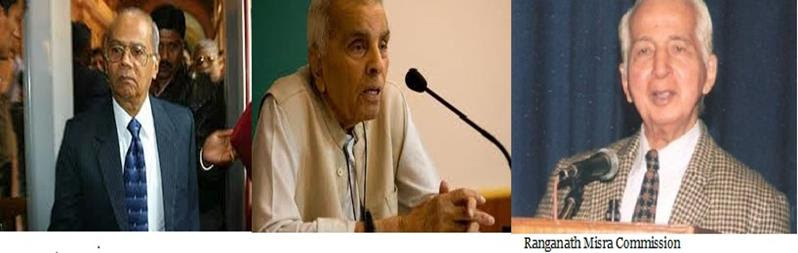
From time to time, respective governments have constituted various committees, to give recommendations to solve the issue of communal violence. Prominent among them are SACHAR COMMITTEE, NANAVATI COMMITTEE and RANGANATH MISHRA COMMISSION.
The Nanavati-Mehta commission, set up by Gujarat government in 2002 to enquire about Gujarat violence.
Sachar committee, appointed in 2005, recommended to set up Equal opportunity commission (EOC) in 2010. EOC was to set up a grievance redressal mechanism for all individual cases of discriminations- religion, caste, gender & physical ability among others.
The Ranganath Misra Commission was entrusted by the Government of India to suggest practical measures for the upliftment of the socially and economically backward sections among religious and linguistic minorities and to include the modalities of implementation for the same. The report of the National Commission for Religious and Linguistic Minorities, headed by former Chief Justice of India Rangnath Mishra, says that 10% should be reserved for Muslims and five% for other minorities in central and state government jobs in all cadre and grades.
The purpose of all above committees is to give recommendations to find out the causes of backwardness of minorities and steps required to improve their conditions.


The Indian law defines communal violence as, "any act or series of acts, whether spontaneous or planned, resulting in injury or harm to the person and or property, knowingly directed against any person by virtue of his or her membership of any religious or linguistic minority, in any State in the Union of India, or Scheduled Castes and Scheduled Tribes within the meaning of clauses (24) and (25) of Article 366 of the Constitution of India"
Though India is under the grip of communal violence, but till now, other than provisions under IPC and CrPC, there is no firm law to punish the originators of such violence, no clear policy for relief and rehabilitation of victims. There is no regulations for security of witness, for accountability of public servants, etc.
'Prevention of Communal and Targeted Violence (Access to Justice and Reparations) Bill, 2011' lapsed in the parliament. The bill provided for a seven-member National authority for communal harmony, justice and reparations. It attempted to safeguard the minority sections. It had provisions for ensuring accountability of the district administration. This has already been recommended by the Sachar committee and Raganath Mishra Commission.
The role of police in communal riots is highly controversial. Generally, riot victims complain that- police did not came to rescue, police forces were themselves instrumental in the killing, they led the mob in looting and burning, arrested the innocent people and harassed them inside the lockup, etc. But as we know, that police can act much better, if there is political will and if they are given free hand along with the implementation of recommended police reforms.
There specialised battalions of Rapid Action force in India, which is a wing of CRPF, to deal with riots, riot like situations, crowd control, rescue and relief operations, and related unrest
Steps required
The solution of such problems cannot be one or two steps by government. Apart from legislative support, administrative efficiency and alertness with the help of modern tools and technology, the major onus lies on the citizens themselves by avoiding communal violence. Though its bit philosophical in nature, as it's not a concrete solution, but the sustainable changes can be brought only by those steps.
Each of us, have to make a balance between our own religious community and national interests, we have to unite with nationalism, and then should move forward. The teachings of a religious community may be great, but the followers of the community concerned should understand that nationalism is greater.  If they do not become familiar with this fact, they will be away from national stream; they will suffer. This fact relates not only to India but also to many other countries of the world.
We have to be rational while making decisions. Each and every religious community has been founded on the basis of certain values that were best and necessary for circumstances of the country and times.  Goodness like adjustment with others, or co-operation, or consistency can be found in their teachings.  But by not moving  according to the teachings of their religious community those who depend upon fundamentalism and conservative practices, or those who use their co-religionists taking advantage of their poverty, illiteracy or innocence, are dishonest towards their own self, their co-religionists and also towards those great leaders who founded the religious community.  Everyone must understand this fact also.  Along with this, leaders of all communities, by knowing it, must come forward for an atmosphere surcharged with harmony, in which lies their welfare too. The religious teachers should promote rational and practical things through religion promoting peace and security.
Policies like appeasement, fun and frolic with the sentiments of people for individual and party interests, and selection of candidates on the basis of religious community or sect by keeping aside the qualifications, one, certainly, does the things against national interest or nationalism; are reflections of lower national thinking.  That is why; these kinds of acts should be stopped at government level and also at the level of political parties.
There is a great need to work towards eradicating the problem of unemployment among the youths, illiteracy and poverty and that too with honesty and without any discrimination.  This will help in solving many problems, and will create awakening.  The result will be in checking on communalism to a great extent.  That is why it is expected that a lot of work have to be done at government level in this direction.
But whatever have been mentioned in above paragraphs, will be effective only when our society and its citizens, become so much capable and empowered, that they can take sensible, ethical and rational decisions. This is possible only with the help of quality education. But quality education for such huge population, cannot be always expected from the public institutions. It is also the corporate social responsibility, it is the responsibility of the educated Indians, NRI and everyone who has roots in India to bring changes in Indian society. So that we can live, the ethos of our constitution and would be able to promote International peace and security too.
Media, movies and other cultural platforms can be influential in promoting peace and harmony. Though all such practises in India are common, but there is still scope for improvement in this direction.

Thus, in order to get rid of the problem of communalism in India, there is a need of collective efforts. All will have to discharge their duties.  If we do so, definitely harmony will prevail.  Everybody will prosper. This must be done; this was the dream of Mahatma Gandhi for a free India.
Challenge of social media and Freedom of expression
Now a day's social media has become notorious for spread of communal hatred. It provides almost instant transfer of provoking material on which our government has no control. It has become potent tool in hands of religious bigots to spread hatred for other religions.
It is true that, Fundamental Rights, under article 19(1), gives citizens freedom of expression. But proviso to this article also empowers government to impose reasonable restrictions to guard unity and integrity of the country. Further, under Fundamental Duties 51A constitution provides –
"(e) to promote harmony and the spirit of common brotherhood amongst all the people of India transcending religious, linguistic and regional or sectional diversities; to renounce practices derogatory to the dignity of women"
This needs to be enforced by state by controlling social media. In olden days, whenever any provocative print media came government invoked its powers and imposed restriction, but yet government has no strong/effective policy towards social media.


Conclusion
Communal violence is common now days throughout the world. They are known by various alternative names, as in China, the communal violence in Xinjiang province is called ethnic violence. Communal violence and riots have also been called non-State conflict, violent civil or minorities unrest, mass racial violence, social or inter-communal violence
and ethno-religious violence.
Violence between Buddhists and the Muslim Rohingya, inhabit Rakhine state (formerly Arakan province) which stretches along most of Myanmar's coast up to the Bay of Bengal and borders the Chittagong province of Bangladesh, erupted in 2013. Such violence in neighbouring countries like Myanmar, Bangladesh, and Pakistan causes violence in retaliation in India also. It also catalyses the problem of refuges, as in case of Pakistani Hindus, etc. Sri Lanka is also facing international critics and United Nations related to ethnic clashes and action of government against minority Tamilians, which has direct bearing on India and Sri Lanka relations and India's internal security.
Increasing diversity, due to influx of populations from all corners of world in western countries like USA, UK, Canada, Australia, etc. is posing the challenge of ethnic clashes and violence in their respective societies.
Communalism can be combated with the help of globalisation as a tool. In the globalised world, all countries are becoming integrated and dependent on each other. Movement of people from one place to other is becoming very easy, in such conditions to avoid such potential violence, governments are already promoting cultural exchanges through shows, programs, heritage walk, cultural visit by students and parliamentarians. Promoting learning of each other's local language for easy exchange of ideas. With respect to this, recently US President Barak Obama's message on Diwali festival can be seen as an active step to promote cultural mingling and living peacefully. If all the countries cooperate with each other, they can face and solve even the deadliest challenge of terrorism and groups like Al-qaeda, ISIS,etc.